




















USAC is a publicly traded (NYSE: UAMY) natural resource company and the only significant antimony producer in the United States — vertically integrated across mining, milling, smelting, and sales.
From the mineral-rich claims of Alaska to smelters in Montana and Mexico, United States Antimony Corporation operates one of the only vertically integrated antimony supply chains in North America. We control the full arc of production — resource access, metallurgical processing, and finished-goods output — giving our customers a secure, domestic alternative to foreign-sourced critical minerals.
Our Alaskan holdings span more than 35,000 acres of historically productive ground, unlocking upstream access to antimony, silver, copper, tungsten, and zinc. That raw material feeds into decades of proprietary metallurgical expertise and two production platforms: our Thompson Falls, Montana antimony oxide smelter and precious-metals refinery, and our recently re-commissioned Madero smelter in Coahuila, Mexico.
“In addition to jobs, raw materials provided by U.S. mines also boost the economy. In 2022, U.S. mines produced approximately $98.2 billion in nonfuel mineral commodities — an estimated $3.6 billion increase over the 2021 revised total of $94.6 billion.”
“Industries including technology, manufacturing, construction, and automotive transform these minerals into the infrastructure and products we use every day, and add trillions of dollars to the U.S. economy.”
“By supporting thousands of jobs and providing essential raw materials, minerals and metals mining is critical to our economy.”
“Together, we can meet the needs of the country without compromising what makes Alaska sacred.”
Alaska is more than a place on a map. It is home to vast wilderness, resilient communities, and a way of life built on respect for what the Unangax̂ (Aleut) people have long called ‘The Great Land.’ For generations, Alaskans have worked hard to balance development with stewardship — working, living, and exploring in harmony with the environment that sustains them.
United States Antimony Corporation (USAC) is committed to being part of that balance.
USAC operates North America’s only primary antimony smelters, producing a U.S. government-designated Critical Mineral essential to national defense, clean energy, technology, and everyday products. In 2024 and 2025, USAC expanded its presence in Alaska, acquiring and staking more than 23,800 acres of claims across the Fairbanks region, Stibnite Creek, and the Maclaren River area; along the southern flank of the Alaska Range. In 2026, USAC expanded its footprint and acquired additional acreage in the Nolan Creek region of the Brooks Range, bringing its holdings in “The North Star State” to more than 27,000 acres. These areas were historically mined for gold and other minerals and contain antimony-rich stibnite left behind by earlier operations.
Our work in Alaska focuses on responsibly recovering these materials, reclaiming and restoring the lands upon completion of operations, supporting local jobs, and reducing America’s reliance on foreign suppliers for a Critical Mineral.
USAC’s approach to mineral development in Alaska is deliberately measured, responsible, and designed to minimize disturbance to the land and surrounding communities.
During the exploration phases, USAC will conduct low-impact drilling which will target then identify small areas for trenching. Coupled with updated geological data, computer modeling, and aerial surveying via a small drone, this approach will result in reduced noise and minimal surface disturbance. These operations will be conducted during daylight hours by a small field team, resulting in minimal impact on local traffic.
Rather than traditional open pit mining, our first excavation work in Alaska will focus on collecting antimony-rich stibnite through identifying and evaluating antimony-bearing zones by targeting areas, including drilling to consolidate the area at hardrock surface, and selective trenching to expose and trace mineralized veins at surface for bulk sampling. In addition, the program includes evaluation of legacy tailings from historic gold mining to identify and recover antimony-rich material that was previously uneconomic or overlooked. All work access will be via existing Alaska roads.
Upon completion, land will be restored by: recontouring land, replacing topsoil and supporting the regrowth of native vegetation. The land restoration will prevent erosion, control sediment, and protect water quality. No infrastructure or debris will be left that requires maintenance by local agencies or residents.
USAC is also partnering with independent Alaska miners and responsible operators to purchase and process antimony-bearing materials already in production. This approach supports local producers and strengthens Alaska’s role in America’s supply chain.
Collected and sourced materials will be processed at USAC’s Fox Logistics Center in Fairbanks and then refined at our Montana smelter. This approach keeps value-added steps in Alaska while keeping final production fully domestic.
Our work is regulated through the state’s Application for Permits to Mine in Alaska process, with oversight from the Department of Natural Resources (DNR), Department of Environmental Conservation (DEC), Department of Fish and Game (ADF&G), and U.S. Army Corps of Engineers (USACE). These agencies ensure water quality, wildlife habitat, and reclamation standards are met at every stage.
USAC’s commitment to Alaska begins with respect for the land and the communities that call it home.
Before initiating new work at Ester Dome in the Fairbanks region, USAC launched a cleanup effort and removed nearly a dozen abandoned vehicles and approximately 50 tons of garbage left by past dumping. This work is part of our commitment to be good neighbors and stewards of the land from day one.
As considerate neighbors, we have pledged to pause activity during major community events like Fairbanks’ beloved Equinox Marathon. Equipment will not operate at night, and project-related traffic will be limited and scheduled to avoid peak times on local roads. During the excavation phases in the Fairbanks area, USAC estimates no more than a single standard truck per day will be transporting raw materials. All project vehicles are monitored via speed monitoring equipment to ensure adherence to posted speed limits.
This project is about more than antimony — it is about doing things the right way, together, so The Last Frontier’s wild landscapes remain places future generations can enjoy.
Our Alaska projects are creating jobs and contractor opportunities in geology, equipment operation, environmental monitoring, transportation, hospitality, and processing. USAC prioritizes partnering with local businesses and hiring local residents whenever possible. If specialized staff are brought in from outside the area, they will relocate to become part of the Fairbanks community.
“Idaho’s industrial minerals — mined responsibly, refined domestically, and built to power American agriculture and industry.”
Idaho is more than scenery and farmland. The Bear River country of southeastern Idaho sits atop one of the most significant high-purity clinoptilolite zeolite deposits in North America — a natural mineral resource with applications spanning agriculture, water treatment, nuclear remediation, animal nutrition, and industrial manufacturing.
BRZ™ produces high-grade natural clinoptilolite zeolite, 85 to 95% pure, directly from our mine and plant in Preston. The product is OMRI Listed® for use in certified organic production and is manufactured in accordance with applicable state feed-control regulations and AAFCO ingredient definitions for natural mineral feed ingredients. Our Idaho operation supports U.S. supply chains for soil quality, odor control, water and air filtration, pozzolan, remediation, flow agents, carriers, desiccants, and animal feed additives — reducing reliance on imported zeolite and keeping value-added production domestic.
Often referred to as the “magic rock” because of its extraordinary natural properties, zeolite is formed through a rare geological process involving volcanic ash and mineral-rich alkaline or saline water. After volcanic eruptions deposit ash into ancient lakebeds or marine environments, the volcanic glass slowly reacts with the surrounding water over hundreds of thousands to millions of years. Through this gradual process of alteration, the ash is transformed into crystalline zeolite minerals such as clinoptilolite, developing a highly ordered microporous structure with exceptional ion exchange and adsorption capabilities. The result is a naturally occurring mineral formed through the interaction of fire, water, chemistry, and time, creating a material valued for its unique ability to selectively capture, exchange, and retain positively charged ions, moisture, and certain unwanted compounds.
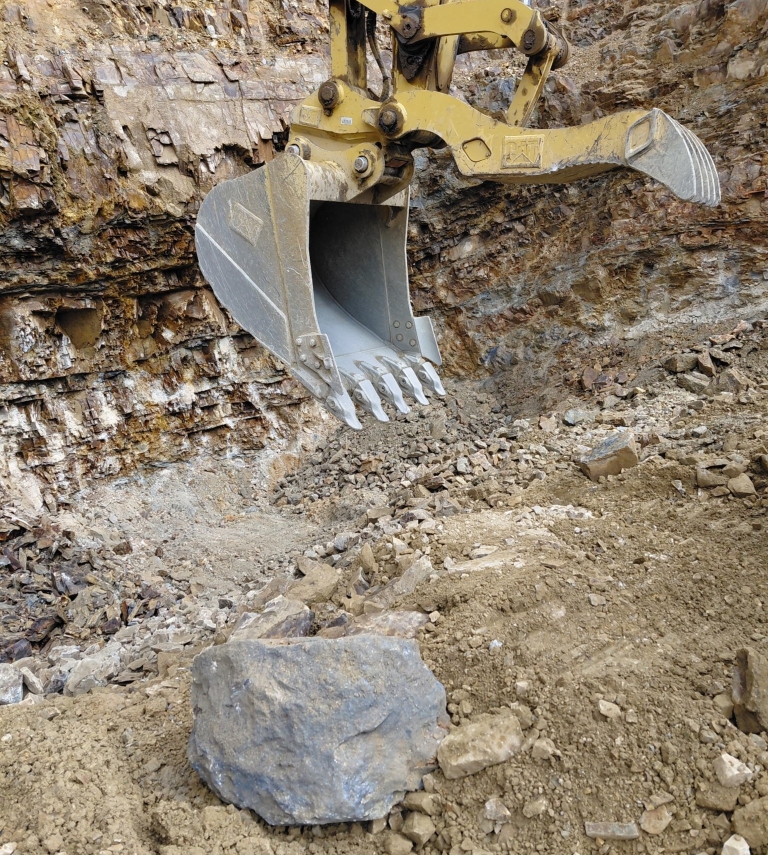
USAC’s mining approach at Bear River is designed for efficiency, low surface impact, and full reclamation. Near-surface rock is ripped where possible; deeper material is drilled with a Tamrock track drill and blasted in 10- to 20-foot benches, each accessed by its own haul road. Overburden — typically 1 to 12 feet of zeolite-rich soil — is stripped with a Caterpillar D8K dozer and stockpiled at the toe of the pit for eventual replacement during reclamation.
Loading is performed with a Liebherr R 965 excavator or a Caterpillar 986B loader, and Caterpillar 769B rock trucks haul material approximately 4,000 feet to the mill. The operation is capable of producing 120 tons per hour. Reclamation plans include drifting topsoil back over mined areas to restore the landscape — and the site is deliberately sited to preserve the surrounding viewshed: from nearby recreational lakes, neither the plant nor the mine is visible.
All mining, crushing, screening, and bagging takes place on-site at the Preston facility. BRZ™ clinoptilolite is characterized by:
These properties make BRZ™ zeolite well suited for agricultural applications (animal nutrition, composting, crop nutrition, soil amendment, pellet binding, flow agents) and a wide range of industrial uses (water and air filtration, pozzolan, odor control, oil and gas, mining effluent treatment, and nuclear remediation).
The Preston operation creates jobs and contractor opportunities in mining, equipment operation, logistics, processing, and customer service. USAC partners with local trucking operators and businesses across Franklin County, and our Idaho facility serves as a domestic source of a strategic industrial mineral that would otherwise be imported.
A Look at Los Juarez
The Madero antimony smelter and precious metal processing facility at Estacion Madero, in the Municipio of Parras de la Fuente, Coahuila, Mexico, is included in our antimony segment.
Construction started on the property in 2009. The property is about 16 acres with seventeen small rotating furnaces (“SRF’s”) and four large rotating furnaces (“LRF”) with an associated stack and scrubbers.
The Madero antimony production is sold as antimony metal or antimony low-grade oxide. In 2019, we completed the installation of a caustic leach circuit to process antimony concentrates from our Puerto Blanco cyanide leach facility containing any precious metals from our Los Juarez property or other sources – both of which are not currently being operated.
Annual antimony finished goods production was 163,788 pounds of antimony metal in 2024, due to the facility being shut down in March of 2024. The Madero facility and operation was upgraded and re-commissioned in January 2025, due to the dramatic increase in demand for antimony processing and the difference in cost metrics with increased commodity pricing.
This property is about halfway between Torreon and Saltilo, both in the state of Coahila on state highway 40, and is accessible by truck. Electricity is supplied by CFE, the socialized electricity provider in Mexico and provides adequate and fairly reliable power. Water is sourced from a well at the smelter. Personnel are sourced mainly from the nearby community of about 100 people.
The Puerto Blanco facility in Guanajuato, Mexico is about 100 acres and is included in our antimony segment. Construction started on the property in 2010. The facility contains a flotation mil and oxide circuit that are used in increasing the concentration of antimony in ore and a cyanide leach circuit this is use in the processing of precious metals.
The flotation mil is not currently being operated but has been used in the past for the processing ore from the Company’s mine in Los Juarez (not currently active) and other unrelated third-party properties.
An oxide circuit was added to the plant in 2013 and 2014 to mil oxide ores from Los Juarez and other properties.
In 2019, a cyanide leach circuit for recovery of precious metals was built and permits were obtained for this circuit. This cyanide leach circuity is not yet in operation and has not been used.
Puerto Blanco had no processing in 2024 with its closure for most of 2024 and processed approximately 20,000 pounds of antimony ore in 2023.
The Puerto Blanco property is approximately 15 kms (about 9.32 mi) north of the city of San Jose Iturbide along state highway 57 in the state of Guanjuato, Mexico.
Although USAC has extensive antimony mineralization at Thompson Falls, Montana, the time and cost of re-permitting the mine as well as the uncertainty of even getting a permit caused USAC to return to Mexico to mine. Most of the Mexican antimony deposits are oxide ores or mixed oxide sulfide deposits. The oxides are recoverable by gravimetric methods, typically jigs and tables. The sulfide ores are recoverable by flotation. During World War II, the United States relied on Mexico for antimony for military applications. Historically, Mexico was at one point the second largest producer of antimony in the world. USAC does not claim any reserves by S.E.C. definitions.
At the Los Juarez property USAC relied on a Mexican Government publication, Consejo de Recursos Minerales, Monografia Geologico-Minera del Estado de Querearo, pages 74-75. The grade of 1,415 tons of rock from the Minasons containing 253 grams per ton silver and 1.8% antimony 40 hectares (100 acres). The deposit was interpreted as a manto (layered) deposit up to 5 meters thick. Although USAC used the report to start mining, it was disallowed by the S.E.C. as a basis for reserves. Detailed mapping and sampling delineated jasperoid mineralization over an east-west strike length of 3.5 kilometers with a maximum width of 1 kilometer. Unlike most Mexican deposits, this deposit is primarily all sulfide. Preliminary exploration indicates that it could be a deep-seated jasperoid. USAC controls this property directly. The grade of 1,415 tons of rock from the Minas Grande area that was milled assayed 0.728% antimony, 6.22 ounces (193 grams) of silver per metric ton, and 0.023 ounces of gold (0.7 grams) per metric ton.
USAC is sourcing mill feed and DSO for Madero from the Soyatal District in the State of Queretaro, Mexico. The deposit was the third largest antimony producer in Mexico. Donald E. White (U. S. Geological Survey Bulletin 960-B, Antimony Deposits of Soyatal District, State of Queretaro, Mexico, 1948) prepared an extensive report and said that the production (p. 40) was estimated through 1943 at 25,630 metric tons of metal contained. USAC has purchased this property but claims no reserves.
Thompson Falls: America’s Antimony Smelter
This plant has a capacity to produce 15,000,000 pounds per year of antimony oxide or 5,000,000 pounds per year of antimony metal.
This plant recovers silver and gold as either a high purity silver metal and/or gold as dore or high purity metal. The current capacity is 10,000 ounces of silver and 50 ounces of gold per month.
Privacy Policy
Welcome to United States Antimony Corporation (“we,” “our,” or “us”). We are committed to protecting your personal information and your right to privacy. This Privacy Policy explains how we collect, use, disclose, and safeguard your information when you visit our website https://usantimony.com/ (the “Site”).
Please read this privacy policy carefully. If you do not agree with the terms of this privacy policy, please do not access the site.
We collect information in two ways:
We use the information we collect for the following purposes:
We use Google Site Kit to help us understand how visitors interact with our website and to improve our services. Google Site Kit integrates several Google services, which may include:
These services collect non-personally identifiable information which may include:
This information helps us to improve our website and its content. Google’s ability to use and share information collected by Google Site Kit is restricted by the Google Site Kit Terms of Service and the Google Privacy Policy. You can learn more about how Google uses data when you use our site by visiting https://www.google.com/policies/privacy/partners/.
We are committed to ensuring that your information is secure. We have implemented suitable physical, electronic, and managerial procedures to safeguard and secure the information we collect online to prevent unauthorized access or disclosure.
We do not sell or lease your personal information to any third parties. However, aggregated, anonymized data collected through Google Site Kit may be shared with Google as part of the service’s functionality.
We use cookies to improve your experience on our website. These cookies may collect non-personal information. You can choose to accept or decline cookies. Most web browsers automatically accept cookies, but you can usually modify your browser setting to decline cookies if you prefer.
Google Site Kit may use cookies to collect information. You can learn more about how Google uses cookies by visiting https://www.google.com/policies/privacy/partners/.
Depending on your location, you may have certain rights regarding your personal information, such as the right to access, correct, or delete your data. Please contact us if you wish to exercise these rights.
We may update our Privacy Policy from time to time. We will notify you of any changes by posting the new Privacy Policy on this page.
If you have any questions about this Privacy Policy, please contact us.